Rooftop Terrace View
Last updated:
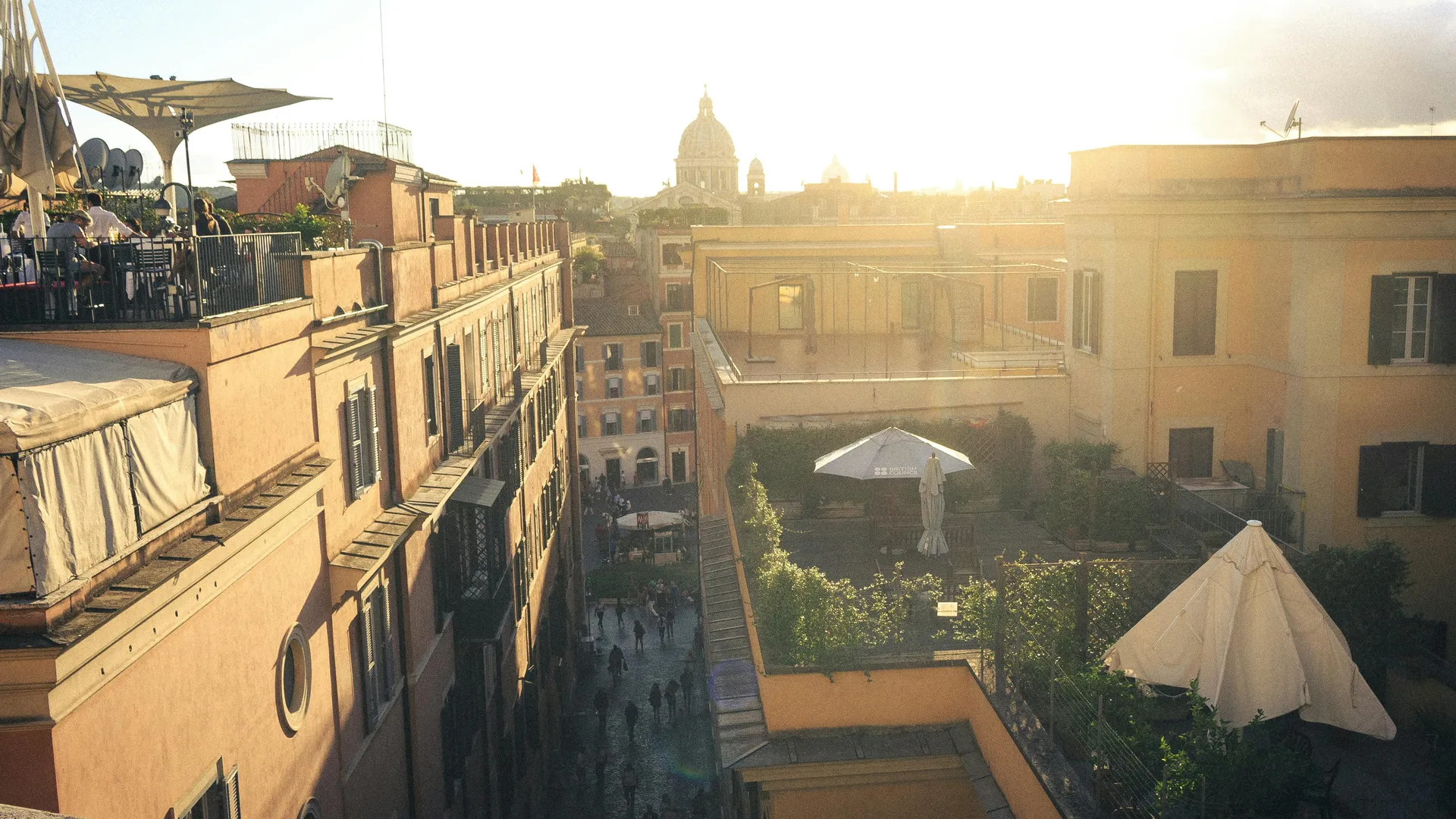
The rooftop terrace sits on the top floor of the palazzo — ten to twelve seats, no bar, no service, just the Roman skyline. Terracotta rooftops, umbrella pines, church domes, and the wide sky. Open 07:00 to 22:00. Everything else is up to you.
Rooftop Terrace View, Not a Rooftop Pool
For travellers searching for a Rome boutique hotel with a rooftop terrace view, this is the version we have: a small guest-only terrace with seating, an open Roman sky, and a clear view over Monti and Esquilino toward Santa Maria Maggiore. We do not have a rooftop pool. If a rooftop pool is the priority for your stay, the larger five-star properties — Cavalieri, Aleph, Sofitel — are the right category and the right page to compare. If a quiet rooftop terrace inside a 24-room boutique hotel in central Rome is what you’re after, the rest of this page describes it.
Your Private View of Rome
The view faces northwest toward Parco del Colle Oppio, the green hill above the Colosseum. Umbrella pines form a dark horizontal line above the rooftops. In the foreground: terracotta tiles, rusted water tanks, laundry lines, satellite dishes — the city as it is lived in, seen from above.
Santa Maria Maggiore’s dome is visible to the left, close enough to pick out the lantern. On clear days the Alban Hills appear to the southeast — the volcanic ridge framing Rome’s southern horizon. No Tiber, no Piazza Navona. The terrace faces the working rooflines of Monti and Esquilino.
Light changes the view more than anything else. Morning sun catches the terracotta to a colour anyone who has been in Rome at dawn will recognise. By midday it goes flat. From 17:00 the western light returns warmth, and by 18:30 the rooftops glow.
When to Visit
Morning: 07:00–09:00
The city is not yet awake. Soft directional light, birdsong, and air that has a quality that vanishes once traffic starts. Bring coffee up from the breakfast room.
Even in summer, 07:00 on the rooftop is cool enough to be comfortable. In October or November the light is extraordinary — long shadows, the low sun catching the Colle Oppio pines. By 09:00 the moment is different.
Afternoon: 14:00–17:00
Not about the view — about air and the change of pace. In spring and autumn the afternoon terrace is excellent for reading, writing, or getting through emails with fresh air. Partial shade from the stair structure appears from roughly 14:00 onward.
This is when the terrace is least busy. Guests are out in the city, and the space is often empty. If you want somewhere outside that is not a cafe shared with fifty strangers, the rooftop at 15:00 on a Tuesday in April is the answer.
Golden Hour: 18:00–20:00
Between 18:30 and 19:30 in spring and autumn, pay attention to your weather app’s sunset time. Chimney stacks and parapet walls go orange, then deepen toward red. The Colle Oppio pines go black against the western sky. Santa Maria Maggiore holds a warm glow longer than anything else.
This is aperitivo time. The hotel has no bar, but Via dei Serpenti has wine bars ten minutes downhill. Buy a bottle, bring it up, watch the light change. You will likely share the terrace with two or four other guests — sociable if you want it, easy to ignore if not.
Evening: 20:00–22:00
At 21:00 on a clear night the terrace offers a version of Rome harder to access from the streets. Illuminated domes, the amber glow of the city, Santa Maria Maggiore lit from below against the dark sky.
Quiet by Roman standards — the streets are still moving but the volume is distant. The terrace closes at 22:00. Worth using at least once during a stay.
How Guests Use the Terrace
Morning Espresso with a View
Collect a coffee from the breakfast room and spend twenty minutes on the rooftop before the city wakes. No agenda — just espresso, the view, and the light. An exposed rooftop above a Roman neighbourhood at 07:15 is an unusually good place to think.
Afternoon Reading Break
After a morning at the Forum or the Colosseum, the terrace offers a place that is neither the room nor the street. Outside, in the open air, with a view that rewards looking at without demanding anything. The Wi-Fi reaches the terrace if you need it for work.
Sunset Aperitivo
Buy a bottle from one of the enoteche on Via dei Serpenti — Ai Tre Scalini is reliable — and bring it up at 18:30. No glasses provided; most returning guests improvise or bring a small glass from the breakfast room.
The setup is not elegant, but the light on the rooftops at that hour is, and the combination works.
Remote Work with Fresh Air
Wi-Fi reaches the terrace, but the space is not purpose-built for working — one small table, no power outlets. Best for tasks requiring only a laptop and a reasonable connection. Spring and autumn are the right seasons; midsummer at 14:00 is not.
What You’ll See from the Terrace
The view is best described in three layers, from foreground to horizon. Colle Oppio pines dominate the foreground — umbrella pines old enough to form a genuine canopy above the park, flat-topped and dense. Santa Maria Maggiore’s dome is the clearest mid-range landmark, identifiable by its lantern rising above the apartment blocks. Rome’s largest Marian basilica, with the city’s tallest campanile, illuminated on feast days. The Esquiline Hill carries the rear of the view east — the rooflines, the church towers, and on the horizon the volcanic ridge of the Alban Hills on clear days.
The roofline of Monti is the main visual material. Terracotta pantiles on older buildings, flat asphalt on mid-century blocks, water tanks in various states of rust, TV antennas that have become inadvertent period detail, laundry lines that animate the view when strung with sheets and shirts.
On clear days — particularly in winter and early spring — the Alban Hills appear to the southeast. The volcanic ridge that formed the soil of the Castelli Romani. Not every day, but when the conditions are right, the hills are there.