How to survive August in Rome: AC, shaded routes, and where Romans actually go
An owner's honest guide to August in Rome — AC that actually works, shaded walks from Monti, pools and lidos that stay open, and why an empty city is worth the heat.
Last updated:
Most of the questions I get by email in spring are some version of the same one: we’re a family of four, or a couple staying ten days, or grandparents with two grandchildren — should we book a hotel, an aparthotel, or just rent an apartment? It’s a fair question, and the right answer is not always Hotel Colle Oppio. After running this place since 2019 — and fifteen years in independent Roman and Florentine hotels before that — I’d rather send someone to the right kind of property than have them spend a week regretting the booking. So here is the honest version of the comparison, written from inside one of the three categories — with a section near the end on when an Airbnb-style apartment is genuinely the better call.
The three categories overlap on the surface and diverge sharply once you stay in them.
A boutique hotel like ours is a small, staffed property — twenty-four rooms, daily housekeeping, breakfast included on most rates, a 24-hour reception, a person to call when the boiler does the thing boilers do at 11pm. You pay nightly. You get serviced. You don’t cook. The trade-off is space: rooms in a nineteenth-century Roman palazzo run from 14 to 22 square metres, which is generous by Roman standards and tight if you’re used to North American hotels.
An aparthotel — the category that includes operators like Adagio, residence-format properties, and several Roman independents — is a hybrid. You get a small kitchenette, a separate sitting area, sometimes a washer-dryer, and reduced hotel services: typically a reception, sometimes daily cleaning, often weekly cleaning bundled into the rate after the first few nights. The nightly price tends to sit between a boutique hotel and an apartment, and weekly rates drop noticeably. You cook some meals; you don’t get a concierge to call ahead to the trattoria on Via del Boschetto.
A serviced apartment or short-let apartment (the Airbnb category, plus the local agencies) is a private flat, usually in a residential building, with a full kitchen, a washing machine, and however many bedrooms you’ve paid for. Cleaning is once at the start, once at the end, with mid-stay cleans available for a fee. There is rarely a person on site. Italian regulations changed materially in 2024 to 2025 — more on that below — and self check-in via key-box is no longer permitted, so you’ll meet a host or a manager at arrival. The price-per-night drops the longer you stay; the services drop the moment the door closes behind the host.
A rough rule for a family of four staying a week in central Rome in shoulder season: a well-located apartment runs least, an aparthotel sits in the middle, a good boutique hotel costs most per night but bundles breakfast, daily service, and the kind of local advice that prevents tourist-menu disasters. Whichever you choose, factor in the tourist tax — Rome charges per person per night by category, with five-star hotels at the top end and apartments and B&Bs lower down the scale. Children under ten are exempt, and the tax caps at ten consecutive nights in the same property. Worth knowing for budget planning, especially for a longer stay.
This is the part I want every family to read before booking an aparthotel, because the gap between the word “kitchenette” on a website and the reality of cooking in a hundred-and-thirty-year-old Roman building is wider than the marketing photos suggest.
A typical kitchenette in a Rome aparthotel or serviced apartment, in a building of the kind that lines the streets of Monti, Trastevere, or the centro storico, looks like this:
What this means in practice: a kitchenette is excellent for breakfast, for warming up market-bought food, for boiling pasta, for preparing simple dinners after a long day at the Vatican. It is not a kitchen for cooking the way you might at home. The romance of “we’ll make our own meals” tends to last about three nights before the family decides the corner trattoria looks easier. Plan for a mix — some self-catered breakfasts and lunches, dinners out — and the kitchenette earns its keep.
The other thing worth knowing: induction hobs require induction-compatible cookware, and most Roman flats are equipped correctly. But the units run on European 230V circuits with limits that don’t always tolerate, say, a kettle and a hob running at full power simultaneously. Tripped breakers happen. The host will know which combination of appliances to avoid.
Honest advice from a hotelier: an apartment is the right answer in several specific situations, and pretending otherwise wastes everybody’s time.
Pick an apartment if you’re staying ten nights or more with three or more people. The maths starts to favour the apartment around night seven or eight, and the practical advantages — a real living room, a washing machine, the ability to do laundry without a five-minute walk — compound.
Pick an apartment if you genuinely want to cook. Not “we might make breakfast”; actually cook. If half the holiday is going to Mercato di Testaccio or Mercato Trionfale and bringing back artichokes, anchovies, and a bottle of Frascati to make dinner, you need a real kitchen. A boutique hotel, even one with a generous breakfast, can’t give you that.
Pick an apartment if you have specific accessibility or layout needs we can’t meet. We have a lift to every floor and ground-floor entry with a single shallow step, but we don’t have a fully accessible bathroom in every room category, and our largest room is 22 square metres. A family of five, or a multi-generational group of six, is genuinely better served by a three-bedroom apartment than by trying to combine our rooms.
Pick an apartment if you want to feel like a resident. Some travellers want to stay in a quiet residential building, walk to the bakery in the morning, and be left alone. Hotels — even small, low-key ones — interrupt that fantasy by virtue of being hotels. An apartment in the right Monti building gives you the resident experience that the boutique hotel category by definition cannot.
If any of these apply, take the apartment. We’ll see you at the bar on Via dei Serpenti.
I should make this section even more specific, because I’ve sent emails like this dozens of times and the savings on the wrong booking are not worth the lost holiday.
A family of five. Two parents, three children. The Superior Room fits a couple plus a travel cot — see our rooms — but five people need either two rooms here or one apartment elsewhere. Two rooms with us costs more than a well-chosen two-bedroom apartment for a week, and the children will probably enjoy having a living room.
A two-week stay where cost is the binding constraint. The longer-stay rates we offer at Hotel Colle Oppio are genuinely better than our nightly rate (email reservations directly), but a serviced apartment with a weekly rate will still come out lower over fourteen nights for most travellers. If the choice is two weeks in Rome at an apartment versus one week with us, take the two weeks.
Anyone who really, really wants to cook. I covered this above. We have a kettle and a mini-fridge in every room. That is not a kitchen. It is a kettle and a mini-fridge.
Travellers prioritising washer-dryer access. A laundry on Via Urbana is five minutes from our front door, and we’ll point you to it, but if you’re travelling with small children and want a washing machine in your accommodation, an apartment is the right pick.
Group travel with one budget split across people. Six adults sharing a three-bedroom apartment near Cavour will pay less per person than three of our rooms. The maths is the maths.
What you do lose with an apartment, post-2024: there is no longer self check-in via key-box — Italian regulations now require in-person identity check, so plan an arrival window. Every short-let property must display a CIN (Codice Identificativo Nazionale), the national identification code introduced in 2024 and required from 2025; if a listing doesn’t show a CIN, the property is operating outside the regulations and I’d avoid it. Mandatory safety equipment now includes carbon monoxide detectors and fire extinguishers. The legal apartment market in Rome is in better shape than it was three years ago. Use it.
We don’t have a “family suite” in the marketing-brochure sense — no two-bedroom unit, no dedicated kids’ bunks, no separate living room. What we do have is a Superior Room category at 22 square metres that works as a family base for a couple plus a small child, and a Superior plus an adjoining Classic Double that can be booked together when both are available.
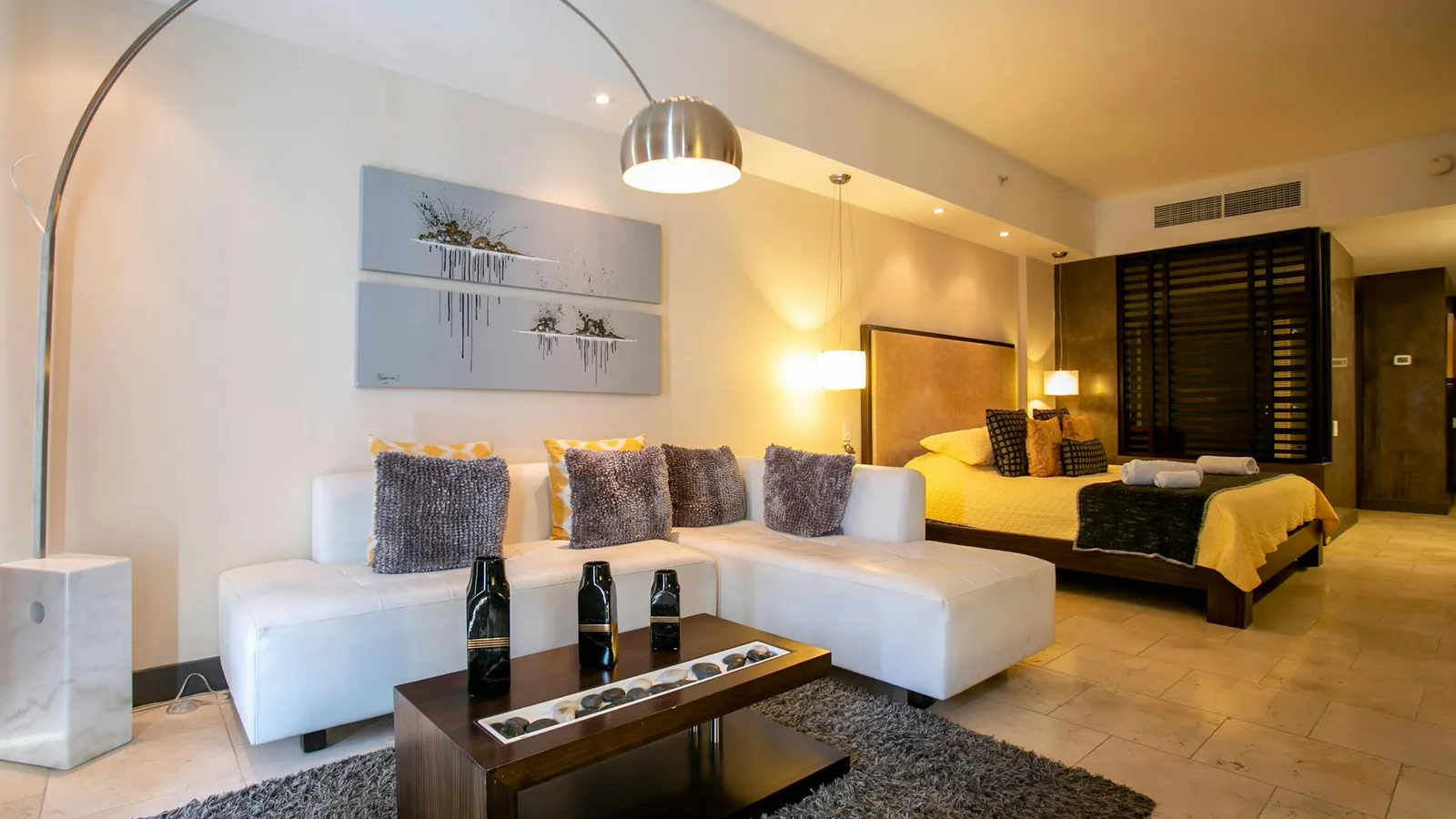
Walking through a Superior Room: you come in past a luggage rack with room to leave a suitcase open, which matters more than it sounds when you’re unpacking for a week. The bed sits against the inner wall — a queen, or twin singles set at booking, made up with 200-thread-count Italian cotton linens. There’s a proper seating area with an armchair, useful for the parent who wakes first and wants to read while the child sleeps. The desk is full-size with USB-A and USB-C ports. A travel cot fits without crowding the room — we keep a few on hand, request one in your booking.
The bathroom has a freestanding walk-in shower, a double vanity with storage on both sides, heated towel rails, and refillable toiletry dispensers. Not a freestanding bathtub — Roman boutiques rarely have those, and we don’t either. Tile floor, no carpet anywhere in the building, which matters for guests with allergies.
For a family of three, Superior Room. For a family of four, Superior plus an adjoining Classic Double if we have the right pair available — flag it in your booking and we’ll hold them if we can. For five or more, take an apartment.
See who stays here for more on how the rooms work for couples, solo travellers, and longer stays.
For stays beyond a week we offer a longer-stay rate that brings the nightly cost down meaningfully. The exact number depends on the season, the room category, and the length of stay — email reservations directly and we’ll quote it. Five nights or more qualifies, and the discount steps down further at seven nights and at fourteen.
On housekeeping for long stays: our default is daily service, between ten in the morning and one in the afternoon. For stays beyond seven nights, many guests prefer a weekly schedule — full clean and linen change once a week, light tidy and towel refresh on the days in between. We’ll set that up at check-in if you tell us. Italian hotel-industry practice on long stays varies, but the workable pattern that most of our long-stay guests settle on is: linens changed every three or four days, towels refreshed daily on request (leave them on the floor) or every other day (hang them up), and one deep clean a week. It keeps the room fresh without the daily knock-and-vacuum that some travellers find intrusive on a working stay or with a small child napping.
Breakfast is included on most rates and runs from seven to ten thirty — friendly to early children, friendly to late-rising adults, with cornetti from a Monti bakery, espresso on a La Marzocco, and proper Italian breakfast staples. Gluten-free, vegan, and lactose-free options on twenty-four hours’ notice.
If you’re weighing options for a family stay or a long stay in Rome and want a sense of what we’d actually charge — and what we’d recommend, including telling you when an apartment is the better call — drop us a line via contact. I read those emails myself.
— Luca Rossi
An owner's honest guide to August in Rome — AC that actually works, shaded walks from Monti, pools and lidos that stay open, and why an empty city is worth the heat.
An owner's honest comparison of the four ways from Rome's airports to Monti — Leonardo Express, FL1, taxi, private transfer — with prices, journey times, and what to do if you land after midnight.
An honest owner's take on the 'hotel near Termini' search: what travellers actually want, why Monti is the eight-minute walk that gives you the same convenience without the station-at-night feel, and the practical train, luggage, and Sapienza tips that follow.